I am burdened with glorious purpose.
I've enjoyed the idea of a shared fictional universe ever since I encountered one during my college studies. Defined in the Urban Dictionary as 'a fictional universe in which multiple individual works are set', it was a concept first introduced to me through the novels of Thomas Hardy. Really. Reading Tess of the D'Urbervilles, I noticed mention of a 'weather prophet' named Fall, who had featured significantly in the plot of The Mayor of Casterbridge. Hang on, I thought, these aren't simply a bunch of stand-alone tales here. The characters in these books all exist in the same version of County Dorset, aka 'Hardy's Wessex'. They have their own stories for sure, but they could conceivably meet each other. And then they could have a good old chat about how miserable and doomed by fate all their lives are. I didn't actually think it in those words, but it definitely occurred to me, and the idea was a very satisfying one.

Hardy wasn't alone in doing it either. Over in America's Deep South William Faulkner was cross-referencing subtly in all his works from The Sound and the Fury to Intruder in the Dust. Agatha Christie dabbled in it a bit, creating the tantalising notion that Hercule Poirot and Miss Marple might by chance have ended up swapping crime-solving anecdotes over afternoon tea. Terry Pratchett wrote largely within his Discworld (over forty novels' worth), with protagonists from one story showing up as bit-players in another. And Stephen King has got on board with the whole idea as his career progressed, so that - for example - a time-traveller in his Kennedy assassination sci-fi thriller 11/22/63 falls into conversation with some of the kids from IT.

Because crafting individual stories that tie together is more than simply a fun idea (and as ideas go it is huge fun). It builds up the suspension of disbelief, reinforcing a sense of reality into which readers or viewers can totally immerse themselves. The glimpse of a character in one film who's played a major role in another has the power to make an audience gasp with the thrill of recognition. (M Night Shyamalan's most recent movie Split provides a prime example of this.)

The Marvel Studio has achieved the creation of a shared universe with unprecedented success, at least in filmic terms. Some critics rue the preponderance of comic-book movies currently in production - but when they're made with such a life-affirming sense of fun and excitement as this Marvel crop, I personally can't complain. I watched the Marvel Cinematic Universe (MCU) movies piecemeal for a while, enjoying them individually, but missing out on all the connections. Finally I succumbed fully to their brash charm and watched the movies in sequence, so that I could relish every character crossover and thematic connection.

Ten years have passed since Robert Downey Jnr's Tony Stark first donned that iconic military-grade armour in Iron Man. To the casual viewer it was a one-off superhero movie, albeit with sequel potential. But stick to the end of the credits and there was Samuel L Jackson as the eye-patched Nick Fury, inviting Stark to join him in something called 'the Avengers Initiative'. That moment set the course for succeeding MCU films - mid-and-end-credit Easter egg moments, linking each story into something broader, while rewarding cinema-going credits junkies for their patience. The Incredible Hulk, Thor and Captain America were all given their own standalone movies, while an Iron Man sequel built up Nick Fury's Shield organisation. This in turn drew together the superhero threads into a huge cinematic gamble...

2012's The Avengers (UK title Avengers Assemble so as not to confuse with John Steed and his various catsuited female associates) banded together a total of six major characters, like Marvel comics had first done in 1963, as a team of global defenders. It might have been an incoherent mess - all action and effects, with some team members hogging the camera while others got sidelined. But no - it was a thrilling, funny, occasionally rather affecting carnival ride, in which every key character got his or her shining moment. And it proved to be a launching pad for something even bigger.
The really big players like Thor, Captain America and Iron Man went off to have their own further adventures, making new friends and occasionally reconnecting as Team Avenger. Simultaneously the MCU became populated with new heroes like Ant Man and Doctor Strange, while being extended to truly galactic dimension via Guardians of the Galaxy. Even Spider-Man joined the cast once Marvel had successfully negotiated the film rights with Sony. The Avengers themselves suffered a major falling-out (Captain America: Civil War), while a vivid new roster of heroes was introduced from the African state of Wakanda (Black Panther).

Some of these films (Guardians in particular) stand apart to be enjoyed purely in their own terms, aside from some sly nods here and there to Marvel comic aficionados. Others contain more obvious connective elements with the other movies. Thus in Spider-Man: Homecoming, Peter Parker has Tony Stark as a kind of mentor, while his nemesis, Michael Keaton, salvages alien technology dating back to the Avengers' first adventure. It can be a touch confusing for casual viewers, but if you're up to speed with the shared universe as a whole, such aspects add a whole other layer of enjoyment (as does each film's inevitable cameo from Marvel Comics' one-time supremo Stan Lee).
Now 2018 brings the MCU's biggest challenge to date (and one of the biggest challenges in the history of cinematic storytelling). In Avengers: Infinity War, to be released later this month, virtually the entire cast of Marvel characters will be - well - assembled, to face down a certain Thanos, the most powerful villain in Marvel Comic history. Even the Guardians will be there, since said super-villain featured significantly in their first movie, and it seems that Black Panther's Wakanda will serve as a major location. It's a gargantuan undertaking, trying to marshal upwards of forty characters into something that isn't, let's be blunt, as messy as a dropped trifle. But you have to admire the ambition.
Other studios are attempting the same kind of shared universe project will lesser success. The DC Comic movies, for example, have tended to cram in too many new characters all at once; their Justice League struggles to prevent character exposition from clogging up the plot. And last year's The Mummy was widely thought to be more concerned with setting up Universal Studio's 'dark universe' than with telling a good story in its own right. MCU played a long-game, however. We're ten years into its gradual, patient world-building, new over-arching plots having being teased, while smaller individual tales were told. It's a remarkable success story, one that continues to delight fans.

Unlike Thomas Hardy's Wessex novels, the Marvel Cinematic Universe has characters from individual stories who do meet and meaningfully interact. They bicker, they banter, they combine forces - taking on opponents too daunting to be tackled alone. Avengers: Infinity War will take this to a whole other scale in a project so huge it borders on folly.
The prospect scares me - and I can't wait.
I just came here to escape.
Ready Player One is directed by Steven Spielberg and based on the novel of the same name - a 2011 science-fiction phenomenon written by geek-extraordinaire Ernest Cline. It explores the potential of virtual reality, while cunningly referencing the pop-culture of the 1980s - futurism and nostalgia wrapped into one slick, eye-popping package. But be warned - its full-on embracing of computer-generated mayhem will alienate some viewers, even as it delights others.

The year is 2045 and America is an over-populated dystopian hell. Wade Watt, a teenager living in a ramshackle San Francisco slum, escapes from his drab life into The Oasis, a vast virtual wonderland. The Oasis' creator, James Halliday (Mark Rylance), was a reclusive genius who shaped his creation from the video games and movies of his youth. Now deceased, he has willed the entire virtual playground (a multi-billion dollar business where real-world fortunes can be made and lost) to whoever can find the golden Easter Egg hidden within it.

Keen gamer Wade takes on the challenge in the virtual guise of suave racer Parzival, along with acquaintances like the hulking Aech (as in letter 'H') and sexy road-queen Art3mis. In The Oasis you can take on any avatar, people's real-world identities (and motivations) remaining questionable. Less of a mystery are the intentions of Innovative Online Industries (IOI), a ruthless corporation whose CEO, Nolan Sorrento (Darkest Hour's Ben Mendelsohn), will stop at nothing, nothing I tell you, to seize the Easter Egg and thus take control of The Oasis.

Ready Player One is my second crazy special effects-fest in a fortnight, but there are aspects that make this one so much better than Pacific Rim:Uprising. It's got a clear narrative through-line for starters, that never drowns in all the spectacular visuals; our hero is making real-world decisions, forming bonds and discovering enemies that influence his virtual-world quest at all points. Spielberg's visual storytelling comes effectively into play, particularly when showing the interaction between real and virtual aspects of the story. And the characters are sufficiently well-established to provide a gravitational centre for the whirl of on-screen craziness. Wade (Tye Sheridan) and Art3mis (Olivia Cooke from The Limehouse Golem) are likeable protagonists, while Mendelsohn proves almost as dastardly a villain as he did in Rogue One.

In addition, the movie is an absolute treasure chest of pop-culture references, with an emphasis on the cinema, video games and music of the inventor's (and Ernest Cline's) beloved '80s. I won't preempt a single one of them, since it's more fun being taken by surprise. How they are woven into the fabric of the virtual world and the plot, however, is consistently ingenious and a potential source of delight - not least to video game nuts.
And that's the point to remember. Ready Player One is a gamer's wet dream and has frantic visuals to match. It answers the question 'What would it be like to inhabit all your favourite games at the same time?', with a number of sequences threatening total sensory overload. More than usual here, one viewer's heaven is likely to be another's hell. Nor does it provide more than flimsy answers to the dystopian questions posed at the story's beginning. Ultimately The Oasis is a vastly more attractive prospect than real-world 2045, which might be a sobering existential comment in itself.
This is a popcorn film - in fact it's a supersized bucket of popcorn with a scoop of mini-Easter Eggs thrown in for geeks of all ages. It won't change the world (in fact it presents opting out as a reasonable alternative), but it's fun. No more, no less.
Gut Reaction: Entertained throughout - not to the extent of the recent Star Wars or Black Panther, but entertained nonetheless.
Where Are the Women?: Olivia Cooke is a heroine worth rooting for, as is... Can't say. Spoiler territory. Oh, and Hannah John-Kamen is a scene-grabbing secondary villain.
Ed's Verdict: 7/10. Magnificently crafted, with enough scintillating detail to make it worth watching again. It's got much more eye-candy than heart, though.
Fire everything you've got!
We live in a blessed cinematic era. Computer generated imagery has advanced to the point where virtually any idea - dinosaur theme-parks, dazzling future-scapes, insane alternative dimensions - can be reproduced onscreen. Just because you can create it, however, doesn't necessarily mean you should. Case in point - Pacific Rim: Uprising.
Don't mistake me - I quite enjoyed 2013's original Pacific Rim. Maybe it's a boy-thing, but there's something irresistible about the phrase 'giant robots versus giant monsters'. It's a simple, fun idea... Strange creatures (kaiju in Japanese) have invaded Earth via a dimensional rift in the ocean floor and are wreaking global havoc. All that's between them and our destruction is squads of gargantuan humanoid machines named Jaegers, operated from within by pairs of cerebrally-linked humans. Guillermo del Toro developed the screenplay for the first outing and then directed it, lending all his visual flair to the story. Idris Elba played Commander Stacker Pentecost (top name!), whose job it was to whip raw recruits into world-saving shape. Spoiler - the humans won.
It was daft. It was the definition of fast-food cinema. But it worked due to an adequate story on which to hang the CGI action, along with zestful execution. Now four years on (ten in terms of the story) comes this entirely unnecessary sequel. Del Toro encouraged it and produced, but frankly he's been off creating real art in the form of The Shape of Water rather than investing time in this flailing mess. It misses his creative input, particularly in terms of the screenplay.

Let me be fair - the opening thirty minutes are okay. John Boyega plays Jake Pentecost (son of Idris), a roguish black-marketeer who makes a living off selling old Jaeger parts. He brings all his Star Wars charm only this time with a Brit accent, and spars entertainingly with Amara (Cailee Spaeny), a fifteen-year-old orphan genius, who has built her own Jaegar from scrap. When both are arrested, they choose enlistment in the Jaeger pilot program over jail and travel to the base in China. Our reintroduction to the place is a reminder of how refreshingly international the first film was - this isn't America rescuing the planet a la Independence Day, it's global salvation through a truly global enterprise. Shortly after our heroes' arrival, however, the whole thing goes to hell - I mean both the world of the film and the on-screen storytelling.

The warning sign comes relatively early. It's when young Amara is walking through the Jaeger-drome, gazing up at the robots in awe and reeling off their names - 'Wow, it's Gypsy Danger, it's Crimson Typhoon, OMG it's Vauxhall Avenger!' (I may have misremembered that last one.) We all know this is primarily a merchandising exercise and that some cinemas will have Jaeger toys ready-wrapped in the foyer, but couldn't the script manage it with a little more style? Or a little more story?

Characters established in the first act fail to be developed, while new ones aren't given enough screen time for anyone to care remotely what happens to them. Some turn on a hair from pseudo-bad to good, or from amoral jackass to hero, with no sense of an actual journey taking place (possibly a result of ruthless editing to leave more room for robot/monster smackdowns). There are good ideas for sure - tensions between a Jaeger drone company and the regular pilots could have provided actual drama - along with glimmers of what might have been meaningful character moments. But ultimately this is an excuse for huge screen-cramming robot battles and the laying waste of entire cities. The CGI is quality, I'll grant you that, and it's even well-directed by Stephen S. DeKnight. But it disengages totally from any kind of emotional investment, so that the unending slam-bang action becomes grimly tedious. Who lives? Who dies? Who gives a damn? I can't even remember the pilots' names!
Boyega does his best to add charm, and Burn Gorman resumes his nutty scientist role from the first movie with commendable energy. But these two struggle along with everyone else not to drown in the CGI tsunami that engulfs all - discernible plot included. Oh, the boredom - we're talking Transformers-level mind-bludgeoning awfulness here, a 'Please-God-make-it-stop' kind of deal. (God didn't make it stop, by the way. I had to wait for the end credits to do that.)
I'd never have believed that something with Del Toro even vaguely attached to it could have turned out this dull, but I stand corrected. Because computer technology, however brilliantly used, will always be rendered dull by piss-poor storytelling. It's a lesson that Hollywood studio executives need to learn - fast and well.
Gut Reaction: Engaged for a while, then not. My cinema-going companion fell asleep. I didn't get that lucky.
Where Are the Women?: Spaeny has potential, but her teen Jaeger pilot is just plain irritating. The rest of the female cast are wasted in barely developed roles. So are most of the males, come to that.
Ed's Verdict: 3/10. Technical wizardry, talented multi-national cast and thematic potential - it all dissolves into a great narrative-lite sludge. This sequel is as dead in the water as a slaughtered kaiju.
Mary, you are my witness.

It's tough for me to approach any 'Jesus' movie purely on its merits as a piece of cinema. Having been raised within Northern Ireland's evangelical community, any retelling of the life of Christ resonates with me in a very particular way. Mary Magdalene is too restrained and cerebral to attract a mass audience - the screening I attended was as empty as the Tomb on Easter Sunday morning - but it fascinated me on a personal level from the opening scene, which possibly skews my perception.

This is very much Mary Magdalene's story, and a version which sets out to redeem her reputation from that of penitent prostitute (as suggested by everyone from Pope Gregory to Rice and Lloyd-Webber). Drawing on both the New Testament and gnostic gospels, and weaving in some imagination of its own, the movie presents Mary as a young woman sensitive to the point of oddness. She is a fisher and a midwife, and also a quiet rebel against the conventional life her family have planned for her. Misunderstood by those around her, it makes sense that she should be drawn to the teachings of a fellow rebel against the norm - a Nazarene preacher-healer, who travels with a group of exclusively male friends. But while Jesus welcomes her into the group, his Disciples are less than enthused by this potentially divisive influence.

Initially this film by Garth Davis (director of Lion) doesn't seem as confrontational as Scorsese's The Last Temptation of Christ. Nor does it have the visceral punch of Mel Gibson's The Passion of the Christ. But by its closing scenes it has proved powerful and subversive in its own right. Rooney Mara's Mary is at the heart of this. As the 'Magdalene' she radiates a quiet depth and intensity that steals scene after scene, even from Joaquin Phoenix's Jesus. It's a sustained exercise in empathy - for everyone from a terrified girl in labour to the Christ himself - one that I found totally compelling.

The scenes between Mary and Jesus are particularly well-judged; Mary comes without any of the male Disciples' agendas and the sense of honesty and friendship is palpable, nor does the film blunder too far down the 'I Don't Know How To Love Him' route. More tricky is Phoenix's playing of Christ's public ministry. It's a very internalised performance - rather too mumbly to explain this man's power over the multitude. One-to-one we see a sensitivity and spirituality at odds with the more blustering expressions of masculinity surrounding him. But he doesn't quite have the charisma here to carry off a memorable Sermon on any Mount.

Much about this movie is restrained, including the stark quality of the cinematography; first-century Palestine looks a cold and bleak kind of beautiful, the effect enhanced by a score that is utterly, hauntingly gorgeous. It all serves to give this retelling of Christ's ministry its own distinctive feel. The film does much in fact to subvert the cliches of traditional Biblical epics, not least in its expansion of Jesus' philosophy from the canonical Gospels (not likely to impress in conservative religious circles). Its presentations of Peter (Chiwetel Ejiofor) and Judas Iscariot (Tahar Rahim) also prove surprising.
More than anything, however, this film keeps Mary and her convention-defying friendship with Jesus at its centre, allowing all else, miracles included, to take second billing. It leads to a denouement that for all my past Bible-reading took me by surprise - and sent tremors down two thousand years of church history. For that alone Mary Magdalene deserves to be watched.
Gut Reaction: Mesmerised throughout, despite the lack of cinematic fireworks.
Where Are the Women?: There's something about Mary - at least when Rooney Mara is playing her. And the screenplay's writers (Helen Edmundson and Philippa Goslett) create a proudly feminist Gospel.
Ed's Verdict: 7/10. I'm tempted to give it more as it struck such a personal chord, but I'm holding back since it's perhaps just too low-key. Still, it's beautifully made, Mara is an understated sensation and the ending delivers an unexpected punch all its own.
Tonight we're taking game night up a notch.
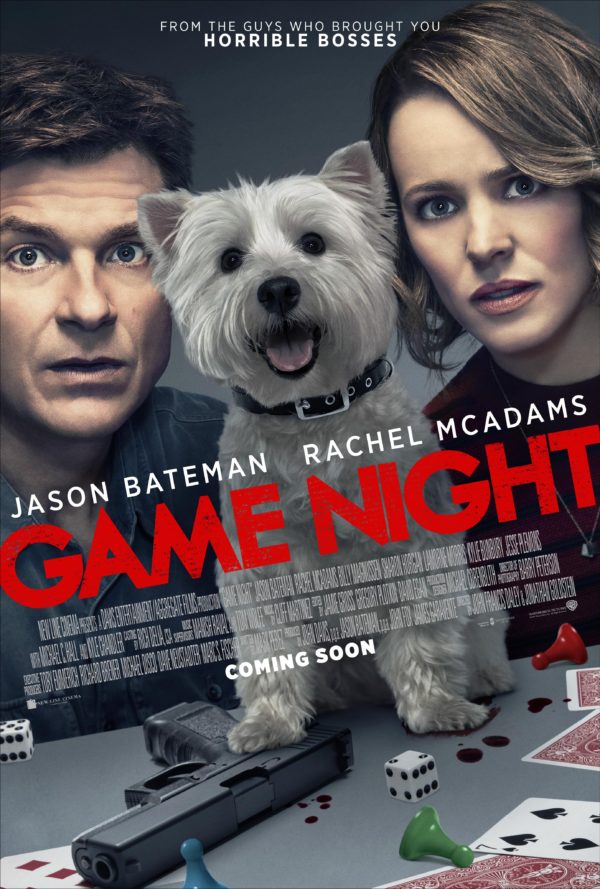
Remember The Game? It's the film David Fincher made in between Se7en and Fight Club, starring Michael Douglas and Sean Penn. The story involved a jaded businessman who paid to take part in a mysterious role-playing game in order to shake up his tired existence. Very soon he was on the run and in fear for his life, no longer able to tell the difference between 'the game' and reality. Well Game Night is a comic take on that premise, with vying couples, rather than a solo guy, immersing themselves in the craziness. And it's a movie that stands or falls on laughter rather than suspense.

Jason Bateman and Rachel McAdams play Max and Annie, a couple who met at a quiz event, recognised themselves as kindred spirits and have been indulging their competitive urges together ever since. Their regular game nights are a hit among their friends. However Max's smug older brother Brooks (Kyle Chandler at his smarmiest) intends to up the ante, arranging a bespoke crime thriller roleplay evening for everyone's entertainment. The real, he assures them, will be indistinguishable from the fake, which naturally sets the movie's whole course. What exactly is going on? And if the unfolding events are all artifice, how come they're starting to appear so painfully real?

To its credit Game Night throws enough variables into the mix to keep the plot bubbling, nor does it feel a need to go exactly the same road as the movie that seemingly inspired it. Much of the comedy stems from feeling a step ahead of the clueless characters, rather than being fooled along with them. Thus we get to watch these idiots wade into dire situations, blithely unaware of the peril. Yes the laughs are broad, but enough of them land on target to keep things ticking over.

Of the gamers Bateman and McAdams are the standout, their chemistry sparking continually, not least in a wonderfully judged scene involving a squeaky-toy. Their sheer likability overcomes my personal bugbear with the movie - the America-centric nature of virtually all the trivia this group chuck around with no hint of awareness in the script. Sharon Horgan (yes, the Irish writer/actress of Catastrophe and multiple other TV comedies) is good when she's allowed room by her gormless gaming partner, an admittedly funny Billy Magnussen. However couple number three - Lamorne Morris and Kylie Bunbury - are tied a one-joke shtick through much of the running-time, rather than being developed in any discernible way. (It's not even a particularly good joke.)

Prepare to see the entire film stolen, however, by Jesse Plemons (Hostiles, The Post), as the awkward neighbour, who's been cold-shouldered by the group and is now desperate to inveigle his way back in. It's an object lesson in less-is-more humour and probably the funniest thing in the show. He also owns a cute dog to which nothing (very) bad happens.
Game Night is a big mainstream crowd-pleaser that would benefit from a bit of script-finessing and a higher one-liner hit rate. It retains its energy throughout, however, even when the plot mechanics inevitably threaten to drain the laughs. If this film keeps hold of its audience, that's largely due to a talented cast - actors who know how to play the comedy game above all others.
Gut Reaction: Satisfactorily entertained, with a few laughs right from the gut.
Where Are the Women?: McAdams is balanced well with Bateman in their loved-up double-act and provided with room to shine as a comedy talent. Give the other gals the same, though!
Ed's Verdict: 6/10. It does more than enough with its premise to justify its existence and the squeaky-toy scene is a moment of comedy genius. I laughed a lot more at Gringo though.
Why do I always get screwed for doing my job?
With Gringo I find myself in the same situation as when I'd watched Downsizing back in January. Here is a film that I genuinely, unambiguously enjoyed, fully expecting that I'd be swelling the reviewing community's huge chorus of praise. Well I'm not, because there isn't one. Gringo has achieved a dire 39% rating on Rotten Tomatoes and a decidedly mediocre 6.0 out of 10 on the Internet Movie Database (IMDb). The world is not in love with this movie. I'm cheering for it all on my own. Well, superior discernment can be a burden, but it's one I'm willing to carry.

The 'gringo' of the title is Harold Soyinka (David Oyelowo), mid-level employee of a US pharmaceutical company, who accompanies his bosses to help tie up their business in Mexico. Industrious and loyal to a fault, Harold has no clue of the corporation's shadier dealings with certain dubious Mexican businessmen. He does have a gnawing suspicion, however, that the future of the business may not include any place for him. Left isolated south of the border with his world rapidly crumbling, the usually mild-mannered Harold resorts to desperate, ill-considered measures to shore up his situation. And from there things start to get very messy indeed.

The chief merits of Gringo from the start are its intelligence and wit. Dismissed by some as a throwaway crime comedy, this is a dark and often deeply funny satire on big business and its propensity for steamrolling the little guy, if he proves no longer essential to requirements. It also delivers a vigorous stab into the heart of the American Dream. Nigerian immigrant Harold has staked all on the promise that hard work and adherence to the rules will be rewarded. Not so - and his reaction when faced with the grim truth is both painful and funny.

Britain's Oyelowo (so impressive as Martin Luther King in 2014's Selma) is a comic delight in the central role. He engages sympathy from the start, something that only increases the further he sinks out of his depth. Harold is the sincere and righteous man, who has been pushed beyond his limit; the unleashing of his pent-up frustration is a deliciously funny sight to behold, never at the expense of the character's pathos. If you're not rooting for him thirty minutes into the film, seriously - what's the problem?

Nor is Oyelowo shouldering the comedy on his own. Joel Egerton and Charlize Theron are a priceless double-act as Harold's truly horrible bosses Richard and Elaine. Their characters are both hilariously-drawn pre-Weinsteinian caricatures, but played with sufficient conviction to make them believable. In a film-long contest for who can be most entertainingly despicable, Theron steals it. Props too for District 9's Sharlto Copley for his turn as a morally conflicted mercenary, who plunges into the rapidly escalating Mexican fray. Always good value, his exchanges with Oyelowo inject heart and humour into what is a sporadically violent ride.

For those who say Gringo is muddled, well - I had no problem with the storytelling and loved its unpredictability. For others who criticise certain sub-plots, I thought it all tied together, thematically at any rate. And for the misguided individuals who dismissed it as sub-par Tarantino, I say it's written with flair and in possession of a moral centre that Quentin T's films lack. Absorbing and consistently funny, this rates with the best crime comedies I've seen in years. And in the flailing form of Harold, it has that something extra.
Gut Reaction: Impressed by its classiness, loving its protagonist and lol-ing a lot. (The running reference involving carrots and bananas is a particular joy.)
Where Are the Women?: Theron shows impeccable comic credentials and Amanda Seyfried shows up to remind Harold that the world isn't all about scumbags. It is a boys-y film though.
Ed's Verdict: 8/10. More satire than most bloody crime capers, but equally more depth. And its seasoned dramatic actors deliver terrific comic performances. I'm proud to be this film's lonely cheerleader.